

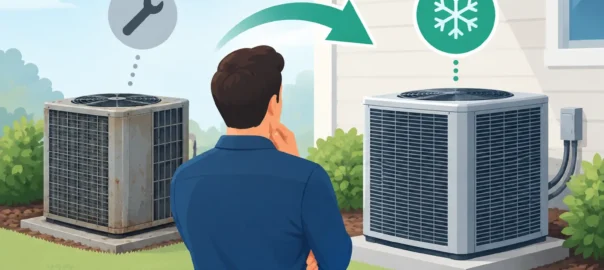
A furnace that quits on the coldest night of the year or an air conditioner that cannot cool the house in July creates an immediate problem. But most replacement decisions arrive more gradually: higher utility bills, repeat repair calls, uneven rooms, and a system that never seems to keep up. Homeowners asking when should an HVAC system be replaced need more than an age limit. They need a clear look at reliability, repair cost, comfort, and what a new system will actually solve.
When Should an HVAC System Be Replaced?
For many homes, a well-maintained air conditioner lasts about 12 to 15 years, while a furnace may last 15 to 20 years. Heat pumps often fall near the air conditioner range because they work year-round. Those are useful planning numbers, not automatic replacement deadlines.
A 14-year-old system that runs quietly, heats and cools evenly, and needs only routine maintenance may have useful life left. On the other hand, a 9-year-old system with a major mechanical failure, poor installation history, or chronic comfort problems may be a poor candidate for another expensive repair.
Replacement becomes the stronger choice when the system is no longer dependable, the repair is substantial, and the equipment is nearing or past its expected service life. It can also make sense when an older unit is technically operational but costs too much to run or leaves part of the home uncomfortable.
The system needs frequent or increasingly costly repairs
One service call does not mean you need a new HVAC system. Motors, capacitors, igniters, contactors, and thermostats can often be repaired affordably. The concern is a pattern: a repair last season, another this season, then a major component failure shortly after.
Pay attention when repair needs move beyond normal wear items. A failed compressor, cracked heat exchanger, leaking evaporator coil, or repeated refrigerant leak can involve a significant investment. If a repair costs close to half the price of replacement and the system is already near the end of its expected life, replacement often provides better long-term value.
The 50 percent guideline is helpful, but it is not a rule that fits every home. A $2,000 repair on a newer, otherwise reliable system may be worthwhile. The same repair on a 16-year-old air conditioner with declining performance may only delay the next disruption. A qualified technician should explain the condition of the entire system, not simply quote the part that failed.
Your energy bills have climbed without a clear reason
Utility rates can change, and extreme weather can push bills upward. Still, a steady rise in heating or cooling costs can signal that HVAC equipment is losing efficiency. Dirty components, duct leaks, inadequate insulation, and thermostat problems can also be responsible, so replacement should not be the first assumption.
A proper evaluation helps separate an equipment problem from a home-performance problem. If the equipment is aging and working harder to deliver less comfort, a modern, properly sized system can reduce waste. The savings vary based on local weather, fuel costs, insulation, thermostat settings, and how efficiently the old system was operating. It is better to view lower operating costs as one part of the decision, not a promise that replacement pays for itself immediately.
Some rooms are too hot, too cold, or too humid
A system that turns on but cannot maintain comfortable temperatures is telling you something. You may notice upstairs bedrooms that stay warm in summer, cold rooms near exterior walls, weak airflow from vents, or a house that feels damp even when the air conditioner is running.
Older equipment may be losing capacity, but the equipment may not be the only issue. Restricted ducts, poor return-air design, insulation gaps, blocked registers, or an oversized unit can all cause uneven comfort. Oversizing is especially common in replacement projects where a new unit is selected based only on the capacity of the old one. A larger system is not automatically better. It may cycle too quickly, remove less humidity, and wear components faster.
Before recommending replacement, the right contractor should inspect airflow, duct condition, system operation, and the home’s heating and cooling load. The goal is not to install the biggest unit. It is to install equipment that fits the home and delivers stable comfort.
The equipment uses R-22 refrigerant
If your older air conditioner or heat pump uses R-22 refrigerant, it does not have to be replaced simply because of the refrigerant. However, R-22 is no longer produced or imported for new use in the United States, which can make refrigerant-related repairs costly and less predictable.
A small repair on an R-22 system may still be reasonable if the equipment is otherwise in good condition. A major leak, compressor failure, or repeated need to add refrigerant changes the calculation. Replacing the system allows you to move to current equipment and refrigerant standards rather than putting major money into technology that is becoming harder to service.
Safety concerns are present
Some HVAC problems are about comfort. Others are about safety. A cracked heat exchanger in a gas furnace, signs of carbon monoxide, electrical damage, repeated breaker trips, or a furnace that produces unusual burning odors requires prompt professional attention.
Do not continue operating equipment that has been identified as unsafe. In some cases, the issue can be repaired. In others, especially with an older furnace and a compromised heat exchanger, replacement is the responsible path. Your family should not have to choose between warmth and peace of mind.
Repair or Replace: Questions That Bring Clarity
The replacement decision becomes easier when you look at the whole picture rather than one number on a repair estimate. Ask how old the equipment is, what has been repaired recently, whether the problem is isolated or recurring, and how well the system keeps your home comfortable.
Also ask what a repair will realistically accomplish. Will it restore dependable operation for several years, or is it simply addressing the latest failure in a system with multiple aging parts? A clear diagnosis should include the immediate repair option, the likely condition of related components, and the risks of waiting.
Comfort matters as much as cost. A system that runs loudly, short-cycles, struggles during peak weather, or leaves humidity high can make daily life frustrating even if it has not completely failed. Replacement is often a planned way to avoid an emergency, giving you time to compare options instead of making a rushed decision after a breakdown.
What to Expect From a Smart Replacement Decision
A new HVAC system is more than an outdoor unit or a furnace in a closet. It is a matched system that includes the right equipment capacity, compatible indoor and outdoor components, proper refrigerant setup, airflow, drainage, electrical connections, and controls.
Start with a thorough in-home assessment. The technician should consider square footage, window exposure, insulation, ductwork, number of occupants, ceiling height, and rooms with known comfort issues. If you are replacing only one component of a split system, ask whether it is compatible with the remaining equipment. Mixing old and new components can sometimes reduce performance or affect warranty coverage.
Efficiency ratings are also worth discussing, but the highest-rated system is not always the best fit. A homeowner who plans to move soon may choose a different option than someone settling into a long-term home. Climate, budget, desired humidity control, fuel type, and available electrical capacity all affect the right choice.
Do not overlook the ductwork. Leaky, undersized, disconnected, or poorly designed ducts can prevent even excellent equipment from performing as expected. A replacement project is a good time to address airflow issues that have made certain rooms uncomfortable for years.
Plan Before the System Forces the Decision
The best time to evaluate aging HVAC equipment is before peak heating or cooling season. You have more time to consider repair costs, compare replacement options, and schedule work around your household instead of reacting to an outage.
Annual maintenance remains valuable even if replacement may be approaching. It can catch safety issues, preserve efficiency, and provide an honest picture of the system’s condition. Keep records of repairs and maintenance visits so you can see whether costs are becoming a trend rather than a one-time event.
If your system is showing its age, ask for a clear, pressure-free assessment. Empire Care can help you understand what is repairable, what is likely to fail next, and whether a replacement would provide the comfort and dependability your home needs. A planned decision today can spare your household from an uncomfortable emergency tomorrow.