

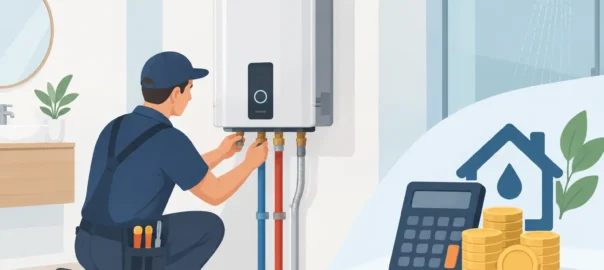
A tankless water heater can solve a familiar household problem: someone starts a shower just as the dishwasher is running, and the hot water disappears. But the tankless water heater installation cost is not just the price printed on the unit. Your home’s fuel source, electrical capacity, venting route, hot-water demand, and local permit requirements all shape the final number.
For most homeowners, a properly installed tankless system is a long-term comfort decision. The right unit can provide hot water on demand, use less space than a tank model, and last longer with regular maintenance. The right estimate should also make clear what work your home needs before installation begins.
What Does Tankless Water Heater Installation Cost?
Installed costs commonly range from about $1,000 to $3,000 for a point-of-use electric unit and roughly $2,500 to $5,500 for a whole-home gas tankless water heater. More complex projects can run higher, especially when a home needs a new gas line, upgraded electrical service, extensive venting, or plumbing changes.
These ranges are useful for planning, but they are not a substitute for an in-home assessment. A low upfront price may exclude the work required to make the system safe, code-compliant, and capable of meeting your household’s demand. A qualified technician should look at the complete installation, not simply swap one box for another.
Gas tankless units typically cost more to install than electric models because they may require combustion-air planning, dedicated venting, condensate drainage for high-efficiency models, and gas-piping upgrades. Electric units can be less complicated in some homes, but large whole-home models often need multiple dedicated circuits and substantial electrical capacity.
The Biggest Factors Behind the Final Price
The unit itself is only one part of the project. Installation costs change based on what your home already has and what must be added.
Fuel type and available capacity
If you are replacing a gas tank water heater with a gas tankless model, you may assume the existing gas line is enough. Often, it is not. Tankless units can require a higher gas flow rate because they heat water immediately rather than maintaining a stored supply. A contractor may need to run a larger gas line from the meter or make changes to the existing distribution system.
For electric tankless units, the key question is your electrical panel. Whole-home electric models can draw significant power. If there is not enough available capacity, the project may require a panel upgrade, new breakers, and dedicated wiring. That can be worthwhile, but it should be visible in the estimate before work starts.
Water-heating demand and proper sizing
A tankless heater must be sized for simultaneous use, not just the number of bathrooms in the home. A family that routinely runs two showers, a washing machine, and a dishwasher at once needs more capacity than a couple with one bathroom and modest demand.
Climate matters too. In colder regions, incoming groundwater is colder, so the heater must work harder to create the desired temperature rise. A unit that performs well in a warm climate may not deliver the same flow rate during winter in a northern state.
An oversized unit can raise purchase and installation costs without adding meaningful comfort. An undersized unit can leave you with fluctuating temperatures or reduced flow when more than one fixture is in use. Correct sizing is where an experienced installer protects both your budget and your day-to-day comfort.
Venting and placement
Most gas tankless systems need a safe venting path. Depending on the model, that may involve stainless steel, PVC, or polypropylene vent materials. The length of the run, the number of turns, the location of exterior termination points, and access through walls or ceilings all affect labor and materials.
A straightforward installation on an exterior wall is often less expensive than locating the unit in a tight utility closet with a long route to the outside. The installer also needs to maintain required clearances from windows, doors, walkways, and other building features.
Plumbing changes and water quality protection
Tankless units may need isolation valves, a pressure-relief valve, drain connections, new shutoffs, or relocated water lines. If the old tank heater sits in a different area, moving to a wall-mounted tankless system can add piping work.
Hard water is another important consideration. Mineral scale can build up inside the heat exchanger and reduce performance over time. In areas with hard water, a water treatment solution or routine descaling plan may add to the initial or ongoing cost, but it can help protect the equipment and preserve efficiency.
Permits, code requirements, and labor access
Permits and inspections are not optional extras. They help confirm that gas connections, electrical work, venting, drainage, and safety devices meet local code. Permit fees vary by location, and some jurisdictions have specific requirements for seismic strapping removal, condensate disposal, shutoff placement, or exhaust termination.
Labor also changes when access is difficult. An attic, crawlspace, finished basement, or narrow mechanical room can require more time than an open garage installation. A clear estimate should identify these conditions instead of surprising you after the work begins.
Gas vs. Electric Tankless Water Heater Costs
Gas tankless water heaters are often the better fit for whole-home use because they can deliver higher flow rates. They are especially practical for households with several bathrooms or frequent simultaneous hot-water use. Their higher installation price can be offset by strong performance and, depending on local utility rates, reasonable operating costs.
Electric tankless heaters can work well for a single sink, a remote bathroom, a garage apartment, or a small home with low demand. They do not need combustion venting, which can simplify placement. However, large electric whole-home systems can become expensive if the electrical panel needs major upgrades.
There is no universal winner. The best option depends on your household demand, available utilities, local energy costs, and the condition of your current plumbing and electrical systems.
When Replacing a Tank Heater Costs More Than Expected
Replacing a traditional tank heater with a tankless unit is an upgrade, not always a direct replacement. A tank model may use an existing chimney connection or basic vent arrangement that is not suitable for a high-efficiency tankless system. Likewise, the gas line that served a tank heater may not support the peak demand of an on-demand unit.
This does not mean a tankless upgrade is the wrong choice. It means the estimate needs to account for the full scope. Ask whether the quoted price includes the unit, removal and disposal of the old heater, new valves, venting materials, gas or electrical upgrades, permits, condensate management, startup testing, and inspection coordination.
A price that seems unusually low may reflect a limited scope rather than a better value. The goal is not to pay for unnecessary work. It is to avoid finding out mid-project that essential work was never included.
How to Get a Reliable Installation Estimate
The most useful estimate starts with a technician evaluating your actual home. They should ask about the number of bathrooms, household size, peak hot-water use, fuel source, water quality, and where the current heater is located. They should also inspect the gas piping or electrical panel, venting options, water pressure, and installation access.
Before approving the work, make sure you understand the unit’s expected hot-water output at your local winter water temperature. Ask what maintenance it needs, how often it should be flushed, what warranty coverage applies, and who will handle permit requirements. These details help you compare proposals fairly.
At Empire Care, the focus is on identifying what the home needs before recommending a solution. A clear installation plan gives you a better chance of getting the comfort you expect without avoidable changes, delays, or added costs.
Is a Tankless Water Heater Worth the Investment?
Tankless systems are often worth considering when space is limited, your current tank heater is nearing the end of its life, or your household wants a more consistent supply of hot water. They can also be appealing for homeowners who plan to stay in the home long enough to benefit from a longer equipment lifespan and potential energy savings.
Still, tankless is not automatically the best answer for every home. A high-demand household with limited gas capacity, insufficient electrical service, or difficult venting may face a higher project cost than expected. In some situations, a properly sized high-efficiency tank water heater may be the more practical choice.
The right decision comes down to honest sizing, complete installation pricing, and confidence that the system will perform when your household needs it most. A careful assessment today can keep your next hot shower from becoming tomorrow’s service call.